Hi I was solving Atcoder arc 193 problem B.
In this editorial, the authors claim that the reason why they subtract out exactly 2 from the sums of three dynamic programming iterations is because only this case: “1, 1, 1, 1…1” will be counted in all 3 DPs.
Specifically, the DP transitions will should like this, with the orange denoting the new set, S2 at dp[i+1][S2] when transitioning from dp[i][S1].
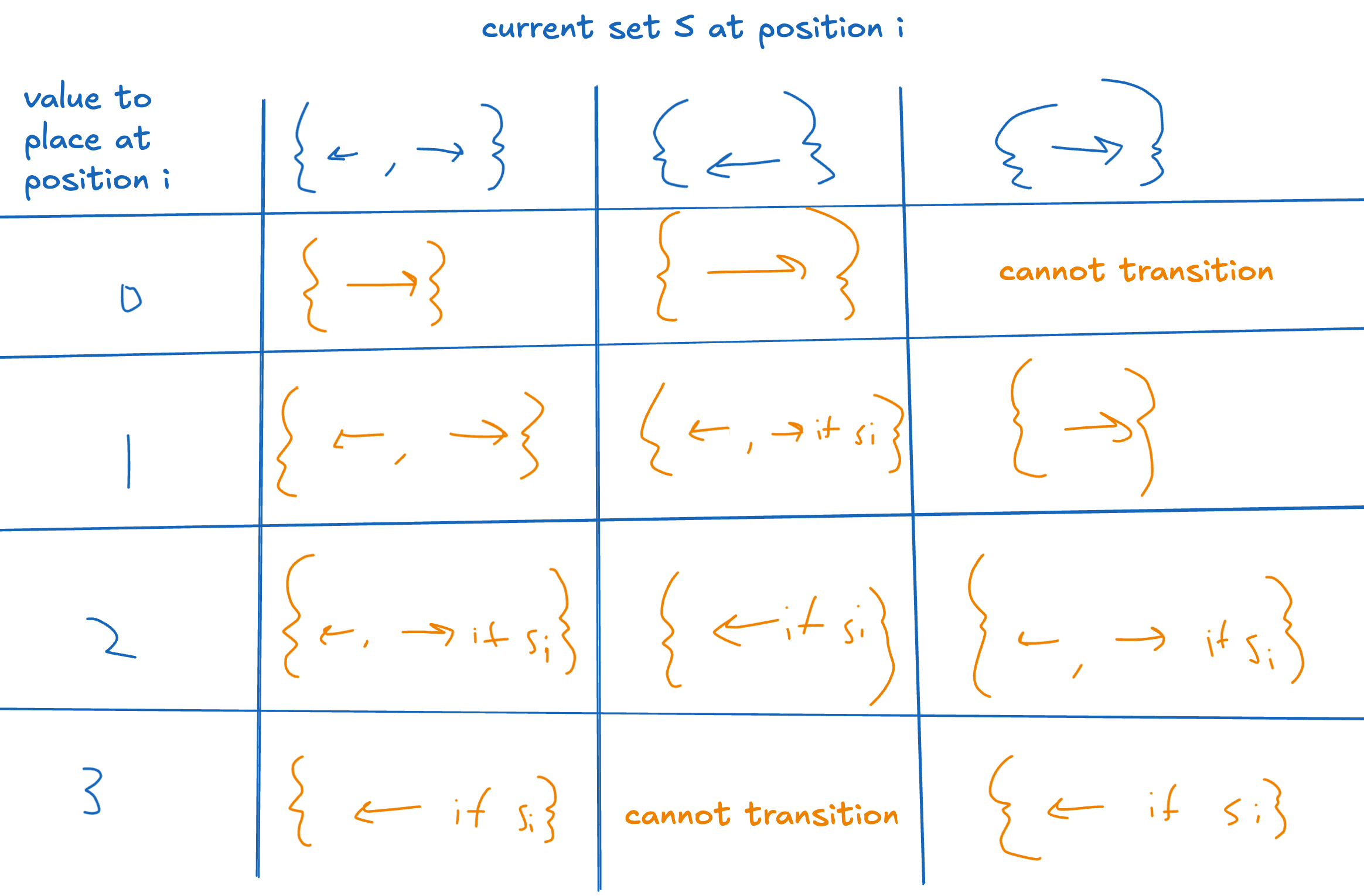
However, when I saw this chart, I realized that the sequence with all degree 2 will also be counted 2 times if si = 1 for all i. In fact, it will be counted when the initial set is {<-, ->}, and when the initial set is {<-}.
This is because if you construct all degrees = 2, and all si = 1:
if you will start from {<-}, you will end up with {<-}.
if you start from {both}, you will end up with {both}.
That means that it will be added to both times you run the DP.
The only reason the editorial’s solution isn’t “wrong” is because in this case, “all degree = 1” case is counted only 2 times, instead of 3.
However, its claim that this is “counted in all three” is wrong. This makes we wonder, how can we prove that there will be exactly 2 overcounts across all three DP?
Thank you in advance!